
Walking & Weight Balance
The Slow Accumulation of Distance: Walking, Step Count and Weight Over Time
Eleanor Whitfield · 10 February 2026
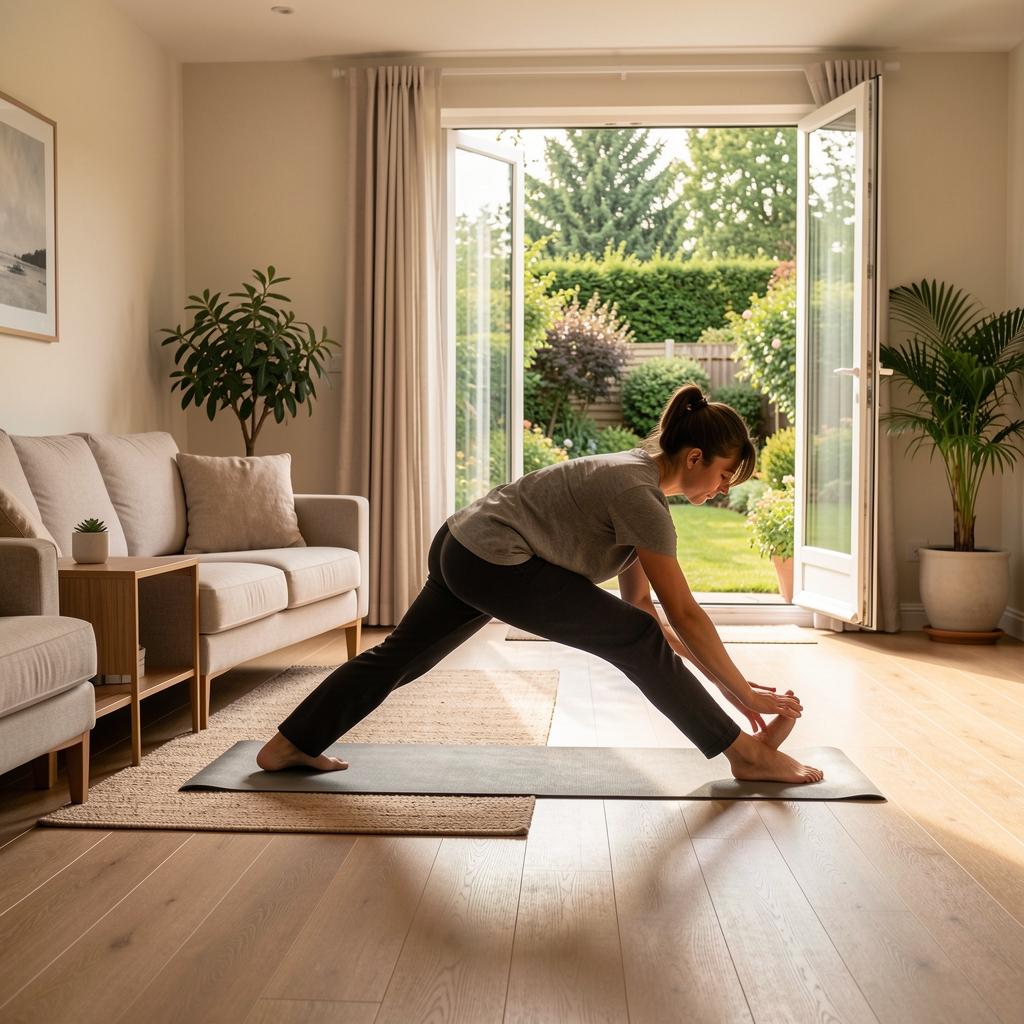
London, January and February 2026. Six participants, all working from home in full-time roles, agreed to introduce structured five-minute movement breaks at the top of every hour throughout the working day for a period of eight weeks. The question was not whether they would lose weight. The question was whether interrupting extended sitting — the dominant feature of the contemporary working day — with modest activity would alter how they felt by mid-afternoon. The answer, across all six, was consistent.
The context for this observation was the post-pandemic restructuring of working life. All six participants had shifted to full-time remote work between 2020 and 2022 and had maintained that arrangement. All reported an increase in sedentary time compared to their previous office-based patterns — the removal of commuting, office circulation, and social movement that had previously been embedded in the structure of the working day.
The characteristic pattern described was a working day beginning at 08:00 or 09:00 at a desk and continuing, with minimal interruption, until 17:00 or 18:00. Lunch was typically eaten at the desk. Movement was largely restricted to kitchen and bathroom visits. By mid-afternoon, five of the six consistently reported a significant drop in concentration and an increase in food-seeking behaviour — specifically the desire for high-carbohydrate snacks between 14:30 and 16:00.
This pattern is well-documented in published research on sedentary behaviour and energy regulation. Prolonged sitting is associated with impaired metabolic function and altered appetite signalling, independent of overall daily physical activity levels. It is possible to meet a daily step target entirely through morning and evening movement and still accumulate eight or more consecutive sedentary hours during the working day — a distinction that the movement break framework was specifically designed to address.
Each participant was given the same instruction: at the completion of each working hour, take five minutes away from the desk and move. No specific activity was structured. The options available in a home environment are modest but sufficient: walking between rooms, standing and performing light bodyweight movements, brief outdoor steps to a garden or doorway, stretching against a wall or doorframe. The emphasis was on interruption rather than exertion.
Participants used different approaches to trigger the break. Two relied on calendar alarms. Two used the natural cadence of phone calls and video meetings as punctuation points. One set a physical timer on the desk. One participant found that setting a water glass at a distance from the desk — requiring them to stand and walk to refill it — was sufficient to introduce a natural movement rhythm without any additional prompting.
"The afternoon slump was still present in weeks one and two. By week four, it had become noticeably less pronounced. By week six, three participants reported that it had largely disappeared."
Field Notes — Week 6, Home-Working Observation
The afternoon slump — the characteristic energy dip and food-seeking behaviour reported at the outset — was still present in weeks one and two for all six participants. By week four, it had become noticeably less pronounced for four of the six. By week six, three participants reported that it had largely disappeared. The remaining three noted a reduction in intensity, if not elimination.
The snacking pattern shifted measurably. At the outset, five participants reported daily or near-daily unplanned eating between 14:30 and 16:00. By week eight, this had reduced to occasional occurrences for three and had ceased entirely for two. This reduction in unplanned caloric intake is directly relevant to weight balance: at typical snack densities, the elimination of one unplanned afternoon snack per working day represents a meaningful reduction in weekly energy intake over time.
Step counts increased substantially — a secondary finding of note. At the outset, average daily steps for the group were between 2,800 and 4,200. The movement breaks alone, accounting for five minutes of walking or light activity across seven or eight working hours, contributed an estimated additional 1,400 to 1,800 steps per working day. Combined with existing movement patterns, four participants crossed the 7,000-step threshold by week four.
One of the more unexpected observations from this period was the degree to which participants began to see their home environment as a movement resource rather than a constraint. The transition to home working is often framed as a reduction in movement opportunity — and in the early stages of the pandemic this framing was accurate. But with deliberate structure, the home working environment offers continuous access to a low-intensity movement context that the open-plan office does not: privacy, flexibility, and no social cost to stopping work at the hour.
Several participants noted that they began using the movement break as a thinking pause rather than a reluctant obligation — walking a small circuit of the flat or garden as a way of processing a decision or clearing attention before returning to a task. This integration of movement into cognitive routine is consistent with published findings on walking and attentional restoration, and it suggests that the benefit of structured breaks may extend beyond the purely physiological.
The household itself — stair use, room transitions, light domestic activity during breaks — contributed to the overall movement pattern in ways that were not anticipated at the outset. Three participants noted that they had begun doing brief stretching or bodyweight movements during the breaks by week three, independent of any instruction to do so. The five-minute framework had created a structure within which further movement behaviour could develop naturally.
The findings from this observation period support the view that the architecture of the working day — rather than the intensity of formal exercise — is the primary variable for many people when it comes to movement and weight management. A working day structured around continuous desk use creates conditions that undermine weight balance not primarily through caloric expenditure but through appetite dysregulation and reduced incidental movement.
The intervention documented here required no equipment, no gym membership, and no structured fitness knowledge. It required only a decision to interrupt sitting at regular intervals and to do something, anything, with the body for five minutes. The body, it turns out, responds to that much. The cumulative effect across a working week — forty or more such interruptions — is not trivial. It represents a fundamental change in the metabolic character of the working day.

Tobias Marsden is senior contributor to Taldore Almanac. His background is in physical education research and public health writing. He contributes long-form field observations focused on movement habit formation and household activity patterns.
Read more from the archive →